EN

Production efficiency and product quality are always of paramount importance for the small and medium scale manufacturing plants. However, numerous production lines continue to adhere to the traditional or manual approach of sealing and adhesive application, subtly costing profits and consistency. Going from manual glue application to automated glue dispensing equipment might be a game-changer, but determining the place to start can come as a daunting task. This checklist offers a systematic path to guide decision makers as they evaluate this vital upgrade.
Identify the Warning Signs
Prior to comparing any new machinery, take a look at your existing process and determine if it is really limiting you. There are a number of clear signs that you're ready for automated glue dispensing equipment.
The first thing you need to look at is your production variability. If cycle times vary significantly between operators or shifts, you lack a consistent process – and a reliable gluing step. Second, take into account your rework ratio. Essentially, you are working a second shift without pay to fix errors if problems with weak bonds or messy cosmetic defects are common due to under-dosing or over-dosing. Third, look at the use of materials. Dripping, stringing or "safety" beads are a hidden money waster because of the amount of adhesive produced. Last but not least consider your employees. Automation becomes a cost of doing business, not a cost of being nice, when defects increase at the end of the shift or when you are having trouble with high defect rates at repetitive glue stations due to operator fatigue. If you recognize two or more of these signs, it's time to take the next step.
Define Your Process and Material Requirements
After you've determined that you have a need, the next step is to specify what you need from the new glue dispensing equipment. A mismatched machine and application can cause costly headaches.
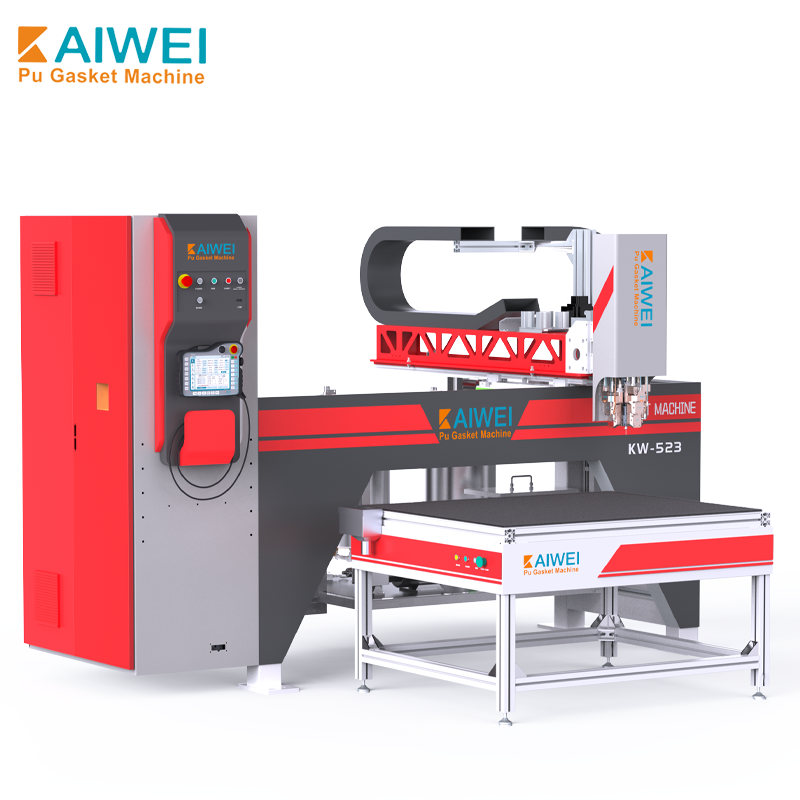
Let's begin with the glue. A variety of pumps and dispensers will be ruled out because of viscosity, cure time and the need for single or two-component mixing (such as polyurethane AB two component systems). Then, take your substrate and the gasket geometry into account. The degree of precision and control of the bead movement will need to be known to calculate the required level of accuracy and motion control. It is also important to know the production volume: if you need a Cartesian system or a high output robotic cell. For example, KAIWEI's product line is divided into various models, such as KW-510 for cabinets and air filters, and KW-520 for plastic boxes and electrical panels, which are specifically designed for different industrial applications. When clearly defining these variables, it will help ensure you choose the right tool for your particular application.
Evaluate Core Hardware and Technology
Glue dispensing equipment's performance is based on its key components. When considering your choices, make sure to watch out for the technology used to make it accurate and reliable.
The heart of the system is the mixing head. A good mixing head means that the material is fully and evenly mixed in polyurethane applications. KAIWEI's mixing head KW-700 and KW-900 are renowned for their precision, some of which are even awarded national invention patents. The motion platform is also a critical factor. For consistent path accuracy, typically within ±0.05mm, a stable, multi-axis (usually 3) robotic arm with servo motors and precision racks is used. Don't ignore the metering system.
Consider Safety, Certification, and Long-Term Value
Compliance and durability are must-haves for all global manufacturers. Make sure your selected glue dispensing equipment complies with the quality and safety requirements in your marketplace. Look for CE, explosive environment certification ATEX, RoHS for reduced hazardous components and ISO 9001 for adherence to international safety and quality management standards. Higher IP ratings, such as IP66 or IP67, provide better protection against dust and water, ensuring long-lasting reliability. Examples of certifications include: CCC, CE, ATEX, IP66/67, and RoHS that demonstrate a commitment to safety and quality for KAIWEI products. Consider this an investment in liability reduction, equipment lifespan, and market opportunity.
Plan for Implementation and Training
Lastly, an upgrade is only successful when it is seamlessly integrated. A comprehensive upgrade plan must include implementation strategy and operator support. Take into account the physical make-up of your premises and how the new equipment fits without requiring a major floor redesign. Use the actual part(s) and adhesive on the system to verify performance and adjust parameters before full deployment. Above all, plan for training. The learning curve is low with the availability of user friendly system and support. For example, KAIWEI's "Kai Yixue" mini-program offers convenient operation learning and technical training, so that beginners can quickly master the skills. Training is an investment in your money – get the most out of it from the start.
Investing in upgrading your glue dispensing equipment is a major step towards operational efficiency. Small and medium manufacturing facilities can use this checklist to make an educated decision that'll improve productivity, quality and profitability for years to come.