EN
One of the most pivotal decisions for any manufacturing process in which glue is used to join, seal or gasket parts is choosing the right glue dispensing equipment. The right system guarantees both product quality and consistency, as well as operational efficiency and cost-effectiveness. There are many different types of adhesives available, ranging from polyurethanes to epoxies and silicones—so it's important to understand how the different systems relate to the characteristics of the adhesive employed. KAIWEI is a leader in intelligent sealing solutions, specializing in offering a comprehensive solution of glue dispensing equipment that can meet these industrial needs.
Automatic vs. Semi-Automatic Systems
The first big classification of glue dispensing equipment is according to automation degree, which directly relates to production scale and accuracy. Semi-automatic glue dispensing machines are usually air-pressure powered and need an operator to regulate the dispensing nozzle. This makes them ideal for those that have a high product mix, changes often, or operate in an application that would not be cost-effective to have completely automated.
Unlike the latter, completely automatic glue dispensers combine mechanical parts of movement, usually a multi-axis robotic arm, and with advanced control systems. This automation guarantees precision, repeatability and production speed. The touch-screen controls for easy route setting, for instance, are standard on KAIWEI's automatic systems, and the system can be configured with advanced tools such as 3D teaching for parts that are more complex. These systems are especially suited for high-volume manufacturing where consistency and high throughput rates are essential.
Metering and Mixing Systems for Multi-Component Adhesives
Two-component (2K) adhesives, such as polyurethanes, epoxies, and silicones are required for many advanced manufacturing applications. These are typically stored separately and need to be carefully metered, mixed and dispensed. Special equipment used for this important task is metering and mixing systems.
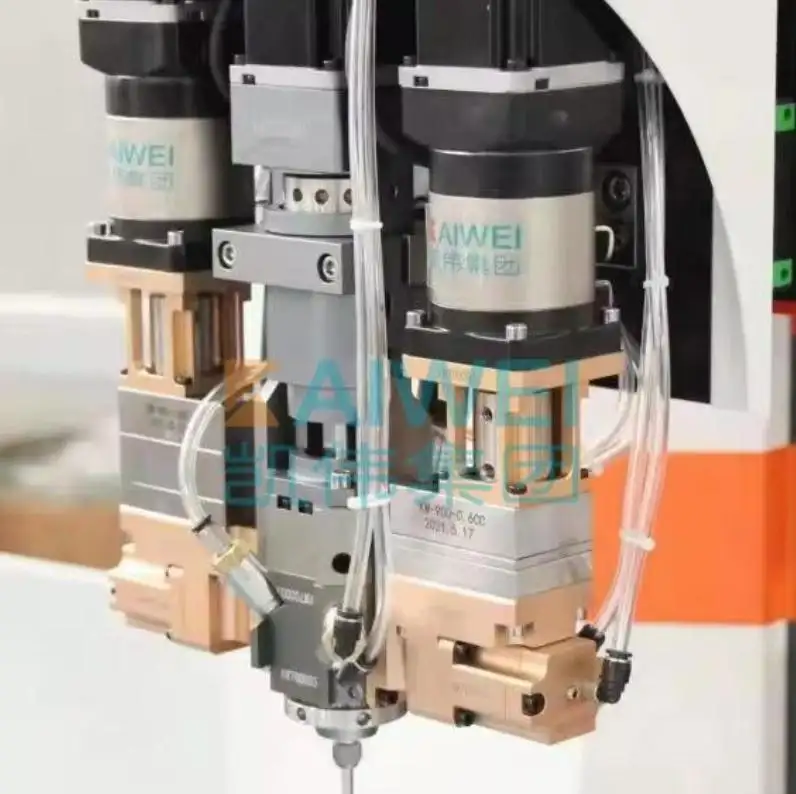
The critical parameter of the success of the process is the accuracy of the metering unit because it determines the ratio and flow of the two components. KAIWEI is the master of the polyurethane (PU) two component dispensing equipment with a series of patented mixing heads such as KW-900, which can realize accurate ratio control and uniform mixing without manual measurement. For producing uniform, quality polyurethane gaskets for use in such applications as automotive battery covers and electrical enclosures, these systems are an absolute necessity.
Single-Component vs. Two-Component Dispensing
This classification corresponds to type of adhesive. Materials that are ready to use, such as one-part silicones, hot melts or cyanoacrylates, are dispensed using single-component dispensing equipment. These systems can be as simple as pneumatic applicators or as advanced as a robot which can accurately apply the material in a controlled pattern.
As mentioned, two-component dispensing equipment is more complicated and includes metering, mixing and dispensing functions. The type of adhesive has a significant impact on the type of system. Polyurethanes, for example, require a particular type of dispensing system, including supply units, temperature control and specialized mixers. The glue dispensing equipment developed by KAIWEI can be used for a single-component material or a two-component material, especially suitable for the precise application of AB two-component polyurethane materials.
Choosing the Right Equipment for Your Application
The final classification depends on the need of the application. Automated foam sealing machine is used for continuous bead of sealant or adhesive for gasketing. This is a typical approach in making environmental seals on enclosures and electrical panels. For potting or encapsulation, a pouring system might be employed to fill a cavity with a protective compound. This table gives an overview of the basic equipment categories and their general use.
| Equipment Type | Application | Suitable Adhesive Types |
| Semi-Automatic Dispensers | Manual application, good for diverse small batch production | Adhesives (epoxies, silicones, polyurethanes) – 1K & 2K |
| Automatic Robotic Systems | High volume, high precision, consistent application of the automatic robot | Polyurethane gasketing: 1K & 2K adhesives: Ideal for polyurethane gasketing |
| Meter & Mix Systems | Accurate multi-component materials (2K) metering and mixing | All 2K epoxies, polyurethanes, silicones and acrylics. |
| Foam Sealing Machines | Sealing Filter Enclosures, Panels, Enclosures - Formed in Place Gasket Sealing | Polyurethane (PU) two-component foams and sealants. |
So, finally, there's no such thing as a one-size-fits-all solution regarding the right glue dispensing equipment. This is related to the particular manufacturing method, chemical characteristics of glue, scale and accuracy of manufacturing. This knowledge enables manufacturers to select systems that are most efficient, maintain product quality, and satisfy their production requirements.