EN
Deciding on portable versus stationary polyurethane foam spray machine can be a major decision that can affect the efficiency of project, operational cost and the growth of business. Configurations meet unique market needs and have unique requirements. With more than 20 years of experience in sealing and dispensing systems, KAIWEI Technology Group has the expertise to assist customers on the right choice of intelligent sealing and dispensing systems in their operation. In this full comparison you will be able to find the best option for you.
1. Output Capacity and Project Scale
First differences between portable and stationary systems is its output capacity; the larger the output, the bigger the projects you can take on.
Portable systems generally have an output of 2 to 8 kg/min which are capable of installing small to mid size projects, like insulation, repairs, room additions, and renovations in residential buildings. For instance, the ability to produce 4.0 to 5.5 lbs/min (1.8 to 2.5 kg/min) is provided by the CPDS Series 2 and the FD-E10 portable electric machine produces 2 to 8 kg/min. These systems are suitable for business start-up or expansion of service that involves moderate quantities of projects, but changes in job locations.
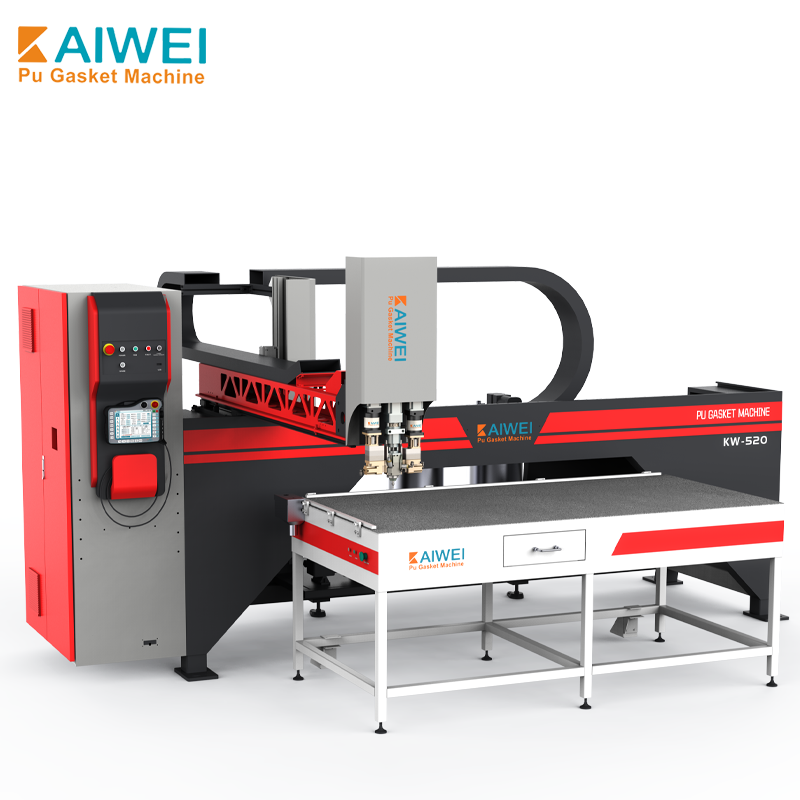
Stationary systems offer significantly greater capacity, ranging from 8–15+ kg/min and will allow continuous operation, and can be used for larger industrial insulation applications, such as cold storage units, warehouses, commercial roofing and high volume manufacturing lines. KAIWEI's KW-520CD, for instance, is stand still system that can be used in industrial precise metering pump and larger tank size (40L per unit) applications. The increased capacity allows for projects to be completed quickly, and enables economies of scale.
2. Mobility, Footprint, and Site Conditions
Portability is mobile system's best feature, whereas stability and integration are the most important features of stationary systems.
Portable systems are intended to be easily moved from one location to another and for flexibility on the job site. The CPDS Series 2 weighs just 155 lbs (70 kg) and is easily operated by one person, the FD-E10 is light enough to be used by one person and operates on standard residential power (120V/230V), and will fit through standard doorways and comes with sturdy wheels for extreme worksites. Perfect for contractors that are continually working on different jobsites, in high rise buildings or in hard-to-reach locations, and necessitates sending tools away in vans or pickups.
Stationary systems need to be allocated certain amount of space and have stable utilities. Approximately 4000×3300×2300mm and 1900kg, KAIWEI's KW-520CD stationary system is designed for high quality video imaging. They are permanently installed in production plants equipped with three phase power supply (380V), the material handling system and complete set of safety devices. They are meant to be used in continuous, high volume production process in controlled factory environment.
3. Operating Pressure and Heating Performance
The quality of the foam is strongly dependent on the pressure and the temperature of the system, with the ability to control them being different for the different types of systems.
Portable systems normally are designed for the working pressure of up to 13.8–17 MPa (138–170 bar) and useful in moderate ambient temperatures for heating. For instance, the FD-E10 can heat up to 88°C (190°F) and can be used with 30meter long hoses. But under very cold conditions portable systems can be difficult to control material temperature, which can impact the foam density and uniformity.
Stationary systems, with higher operating pressure (up to 2,000 PSI), greater amount of heated hoses can be supported (up to 90m or more) and better heating capacity, stationary systems are used. These systems include independent zones, digital temperature control and constant output temperature with continuous long hose usage. KAIWEI's stationary equipment, which is fitted with Germany BARMAG high accuracy metering pumps, can give repeatable accuracy of mixing within ±1% and precise ratio control, which can achieve consistent quality of foam even in harsh industrial applications.
4. Application Versatility and Material Compatibility
The number of applications and materials that can be used with it is quite different for portable and stationary.
Portable systems generally can only accommodate very limited number of formulations, usually single formulation that is designed to be used in the formulation, commonly 1:1 fixed ratio systems optimized for polyurethane spray foam. The CPDS Series 2 is available with both open and closed cell (1.0 PCF and 1.75 PCF) foam formulations, but has limited ratio adjustability. The single problem of these systems is that they are ideal only for very simple use of insulation where variety of formulation is not critical factor.
Stationary systems have greater degree of versatility, with adjustable proportions of mix ratios ranging from 1:1 to 10:1 and are compatible with variety of the foam types such as rigid insulation, flexible foam, structural foam and protective coatings. Polyurea coatings (higher working pressures up to 350 bar) may be used in combination with the traditional polyurethane foams with KAIWEI's stationary equipment. This versatility allows manufacturers to transition between the various product lines such as appliance insulation, automotive parts and coatings for industrial applications, with no equipment change over.
Conclusion
Portable foam spray machines and stationary foam spray machines come in various sizes and types and are used in different projects based on different project sizes, project locations and application requirements. Portable systems are mobile, can be used for small-to-mid projects and in field applications and are relatively inexpensive. Stationary systems offer greater capacity, performance and flexibility for industrial production, at large scale. KAIWEI Technology Group provides the solutions for both types, and is certified by CE, ATEX and ISO 9001:2015. Before choosing the right one for you, reach out to our team and they'll assist you in choosing the right system for your needs.