EN

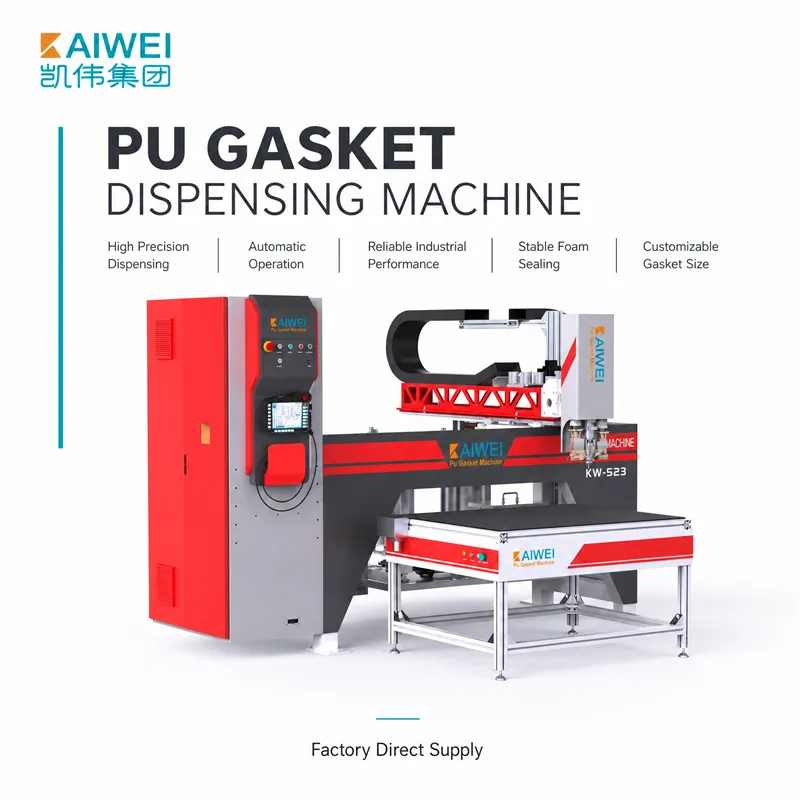
The performance of the high pressure polyurethane foam injection machine is not only related to the raw material quality and compatibility of the machine, but also depends on the raw material quality and compatibility. Matching the materials properly, the foam quality is maintained, it has the best reaction rate and production is ensured. KAIWEI Technology Group has more than 20 years experience in "intelligent sealing and dispensing systems" and grasp the importance of raw material selection. This guide provides a comprehensive overview of raw material matching for high-pressure polyurethane foam injection machines.
1. Understanding the Two-Component System
The high pressure polyurethane foam injection machine is made up of 2 components: the Polyol (Component A) and the Isocyanate (Component B). These components are kept in separate temperature controlled tanks, and are fed to the mixing head by high precision metering pumps with a pressure of about 100-200 bar with impingement mixing.
The hydroxyl functional groups in the polyol component are used to react with the NCO groups of the isocyanate which is used to create the polymer, polyurethane. It is crucial to match both of these to produce the foam properties that are required such as density, hardness and cell structure. The mixing ratio is normally from 1:1 to 10:1, according to the formulation, and has to be carefully controlled, to ensure complete reaction and uniform foam quality.
2. Material Viscosity and Temperature Considerations
Viscosity is an important factor in the handling and mixing performance of materials. The typical viscosities of the raw materials at 22°C of a high pressure polyurethane foam injection machine are around 2500 mPa·s for the polyol and 1000 mPa·s for isocyanate. In the case of higher duty viscosity materials, higher temperatures may be necessary to obtain the proper flow and mixing of the materials.
Consistent properties of the material are essential; therefore, it is important to control temperature. The temperature of materials is usually kept at 25°C to 45°C, and is allowed to fluctuate only by ±2°C. The reaction kinetics of the process will be changed if the temperatures go outside the desired range, which will result in variations in cream time, gel time and properties of the final foam. KAIWEI's equipment is equipped with accurate temperature control system to guarantee the consistency of the material even under different ambient temperature to provide reliable production of a variety of formulations and applications.
3. The Isocyanate Index: Balancing Performance and Cost
One of the most important parameters in formulating the polyurethane foam is the ratio of the amount of isocyanate to the theoretically required amount of isocyanate, also known as the isocyanate index and is expressed as a percentage. This index will affect the final characteristics of the foam such as its fire resistance, thermal insulation and dimensional stability.
If greater fire resistance is desired, increase the isocyanate index (usually ≥ 250) to increase the amount of isocyanurate bonds, and to achieve the desired fire resistance, there is little compromise in the thermal insulation properties. However, the production of a product with an excessive isocyanate index (above 1000) may not provide much benefit to the product, but incur higher production costs. KAIWEI's high-pressure injection machines feature programmable recipes that allow quick switching between various isocyanate index settings, enabling manufacturers to produce a wide range of foam formulations with repeatable accuracy.
4. Practical Matching and Quality Verification
Matching of raw material for successful production needs to be done systematically before going into full production. The typical approach involves flow rate calibration and ratio checking in which the output from each component is sent to different containers for the flow to be calibrated for a specified time and the ratio to be verified. Any pump speed or stroke changes required to bring the A:B ratio to within the tolerance of ±2%, if it is outside of the tolerance, must be made until it is within the tolerance.
Test shots into open cups can be used to confirm the cream time (3-8 seconds in the case of flexible foam), gel time (20-50 seconds) and the tack-free time. When the reaction time deviation occurs, it is most likely that there is a problem with the temperature of the materials, a problem in the mixing ratio or a catalyst problem. The repeatable mixing accuracy of ±1% (weight test) is achieved by KAIWEI's equipment which is powered by Germany Barmag high-accuracy metering pumps and has advanced control systems, allowing manufacturers to be confident in product quality.
Conclusion
To get the best performance from high pressure polyurethane foam injection machines, it is crucial to have a good match of the raw materials being used. Through the knowledge of the two-component system, the control of the viscosity and temperature, optimization of the isocyanate index and systematic quality verification, manufacturers can get the same quality foams. Our equipment at KAIWEI Technology Group is built to accommodate accurate material matching for various formulations, and has been certified as CE, ATEX and ISO 9001:2015, ensuring its safety and reliability. Aligned with us, maximize polyurethane processing and get the highest-quality products.